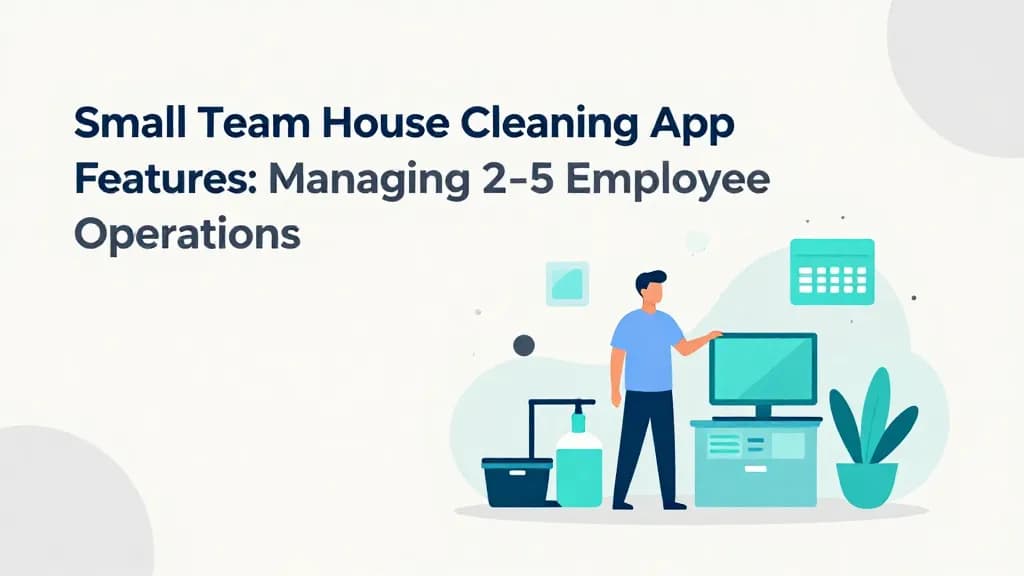
Small Team House Cleaning App Features: Managing 2-5 Employee Operations

Ugo Charles
Going from solo operator to managing 2-5 employees is the hardest transition in a service business. Suddenly you need scheduling, time tracking, and team coordination — but the last thing you need is software that adds more complexity than it solves.
The right app handles that coordination cleanly. Here's what actually works for small cleaning teams in 2026.
Team Scheduling That Actually Makes Sense
Scheduling multiple people is where most small service businesses fall apart. One missed text and suddenly nobody knows where they're supposed to be.
Smart Job Assignment The best apps learn your team's strengths. If one employee excels at deep cleans and another is faster with move-outs, a good system remembers those patterns and suggests assignments automatically — so you're not mentally sorting every job yourself.
Visual Planning Tools You need to see everyone's week on one screen. When a client reschedules Tuesday morning, you should instantly spot who's available without sending a group text and waiting for responses. Route planning becomes crucial when coordinating multiple crews across town.
Conflict Prevention Good apps catch your mistakes before they become client disasters. Double-booked employees? The system flags it. Scheduled someone for jobs on opposite sides of town? You'll get a warning. This stuff happens when you're busy – smart software prevents the chaos.
Dynamic Routing When each team member hits 3-4 jobs per day, efficient routes save serious time. Apps with built-in optimization can cut 45 minutes of driving from each person's day. That's either more jobs or earlier quitting time – both good for business.
Time Tracking Without the Big Brother Vibe
Time tracking isn't about catching people slacking. It's about fair pay and knowing your real job costs.
Location-Based Check-ins Employees clock in at the job site, not their driveway. GPS verification means accurate arrival times and gives clients confidence their team showed up on schedule. No more "I'm five minutes away" texts that stretch into twenty.
Detailed Job Logs Track time per client and task type. This data reveals which properties take longer than expected and helps you price future work accurately. That "two-hour" house that consistently takes three? Now you know to adjust.
Travel Time Separation Most service businesses lose money by not tracking drive time between jobs. Separate logs for travel versus work time help you price services properly and ensure fair employee compensation.
Payroll Integration Your time data should export cleanly to QuickBooks, ADP, or whatever payroll system you use. Manual data entry wastes time and creates errors that nobody wants to deal with during pay periods.
Communication Tools That Keep Everyone Connected
Clear communication prevents 90% of small team disasters.
Centralized Messaging Keep work conversations in the work app. When schedule changes get mixed into personal text threads with family photos and weekend plans, important stuff gets lost. The best customer management systems include built-in team messaging.
Job Notes and Updates Employees need space for job-specific notes. "Client's dog is friendly but jumpy" or "Bathroom faucet needs attention" – these details improve service quality and prevent awkward situations.
Photo Documentation Before/after photos protect your business and showcase results. The process for employees to capture photos and attach them to job records should be seamless — two taps at most. Some clients love seeing the transformation, others just want proof of completion.
Direct Client Updates Many 2026 apps let employees send arrival notifications or completion confirmations straight to clients. This reduces your administrative load while keeping customers informed without constant phone tag.
Quality Control Without Micromanaging
Maintaining consistency across multiple employees challenges every growing service business.
Digital Checklists Standardize your process with mobile checklists employees complete during each job. This ensures consistent quality and gives you data about what's actually getting done. When scheduling apps include customizable checklists, you can tailor them to different service types.
Client Feedback Integration Capture and organize customer comments automatically. When Mrs. Peterson mentions the bathroom mirrors need more attention, you can address it with the specific team member and prevent repeated issues.
Performance Analytics Track completion times across similar jobs. If one employee consistently takes 30% longer, they might need training or have discovered more thorough methods worth sharing with the team.
Supply Tracking Monitor who's using what supplies. Unusual consumption patterns might indicate waste, theft, or training opportunities. Some employees use twice the product because nobody taught them proper dilution ratios.
Growing Smart: Solo to Small Team Transitions
Moving from one-person operations to managing others requires completely different app features.
Role-Based Access You need admin control while employees access their schedules and job details. Look for systems with permission levels that make sense – employees see their stuff, you see everything, nobody gets overwhelmed with irrelevant information.
Business Intelligence Solo operators track performance mentally. With teams, you need actual data. Revenue per employee, customer retention rates, job profitability – this information guides hiring and pricing decisions. Understanding the field service math becomes crucial as you scale.
Training Resources New employees need system access and guidance. Apps with built-in help sections or training modules reduce your onboarding time. You shouldn't spend two hours teaching someone how to clock in and update job status.
System Integration As you grow, you'll add accounting software, marketing tools, and other business systems. Your field service app should connect with these tools instead of creating data silos. How well your tools integrate determines whether your tech stack helps or hinders growth.
Choosing the Right Solution for Your Team
The jump from solo to small team operations changes everything. Your app needs coordination tools without enterprise complexity.
Start with your biggest headache. Scheduling chaos killing productivity? Focus on team coordination features. Losing money on incorrectly estimated jobs? Prioritize time tracking and analytics. Can't maintain consistent quality? Look for digital checklists and performance monitoring.
The best app is the one your team actually uses consistently. Perfect features don't help if the interface confuses your employees or runs slowly on their phones.
Test thoroughly during trial periods. Have your actual employees use the system for real jobs, not just demos. Their feedback matters more than marketing materials. If your team finds the app frustrating, productivity suffers regardless of capabilities.
Fieldtics is built for exactly this stage of growth. The Professional plan ($29/mo) includes team scheduling, real-time field tracking so you always know where your crew is, expense tracking, and a mobile app with push notifications and on-site photo capture. If you're still a solo operator weighing whether to hire, the free starter tier lets you try Fieldtics before you need the team features — so you're already set up when that first employee starts.
Whether you run a cleaning business scaling in a large metro, a janitorial operation managing shift crews across buildings, or a landscaping company dispatching multiple crews daily, the same coordination principles apply. Start with Fieldtics for free and see how much simpler small-team management can be.