How to Start a Pressure Washing Business in 2026 (Step by Step)

Ugo Charles
Almost everyone who gets into pressure washing starts the same way. A $300 gas machine from the hardware store, a driveway that comes out looking new, and a neighbor who asks what you'd charge to do theirs. The gap between that and a business doing six figures a year is not a bigger machine. It is everything around the machine: the LLC, the insurance that pays out when you etch a customer's glass, the runoff rules that can get you fined, and a way to keep jobs, quotes, and invoices straight once the phone starts ringing.
This guide covers that gap. You can launch a lean residential operation for roughly $3,000 to $5,000 and a more professional rig for $8,000 to $15,000 or more. We will walk through the equipment that actually earns its keep, how to register and insure the business, the wastewater rules most "how to start" posts skip entirely, what to charge, and how to get booked solid in your first season.
Is Pressure Washing a Good Business to Start?
Yes, and the math is friendlier than most trades. Consumable costs per job are small (bleach, surfactant, fuel), so once your schedule fills, margins run high. Industry guides commonly cite 60% to 80% profit margins on residential work, and per-job revenue lands in the $250 to $400 range for a typical house wash.
A side-hustle operator working seasonally can pull around $54,000 a year in revenue. A full-time solo operator in a market with 8 to 9 workable months can realistically reach low six-figure annual revenue if they stay booked and price correctly. Net income after fuel, chemicals, insurance, advertising, vehicle, and taxes is lower than the topline, but the cost structure favors the operator who hustles.
The catch is seasonality. In most of the country, pressure washing is a spring-through-fall business, the same revenue-shape problem that shows up in trades like starting an HVAC business. Plan your year around it: bank cash in the busy months, and chase recurring commercial work (HOAs, property managers, restaurants) to flatten the slow stretch. The operators who survive are the ones who treat the winter gap as a planning problem, not a surprise.
Tip: The fastest income jump in this trade is not a faster machine. It is adding higher-ticket services to the same truck: roof soft-washing, deck and fence restoration, and gutter cleaning all sell to the customer who just paid you for a house wash.
Equipment You Actually Need (Budget vs Pro)
You do not need a $20,000 trailer rig to start. You need a machine that can handle real exterior work, a surface cleaner so driveways do not take all day, and the gear to do it safely. Electric units that run $100 to $500 are generally underpowered for serious siding and concrete. Start with gas.
Here is the gear that matters, with realistic 2026 costs from current industry sources.
| Item | Budget (residential) | Pro (commercial-ready) | |---|---|---| | Pressure washer, gas (3,000-4,000 PSI, 2-4 GPM) | $800-$1,500 | $1,500-$3,000+ | | Surface cleaner (16"-20") | $150-$300 | $150-$300 | | Hoses and reels (100-200 ft) | $200-$400 | $200-$400 | | Nozzles, wands, extension wand | $100-$300 | $100-$300 | | Chemicals (bleach, surfactant, degreaser) | $100-$500 | $100-$500 | | Safety gear (gloves, goggles, boots, hearing) | $100-$300 | $100-$300 | | Water tank + trailer/rack (optional) | not yet | $1,400-$4,200 |
Costs above are drawn from workzen, vandaliarental, and lucidbots 2026 guides.
What to buy first, what to skip
Buy the gas washer, the surface cleaner, and good hose first. A surface cleaner alone turns a streaky two-hour driveway into a clean 30-minute job, and it is the single best ROI purchase after the machine itself.
Skip the water tank and trailer at the start. Most beginners hook to the customer's spigot, which is fine for residential. A 100 to 200 gallon tank plus plumbing runs $400 to $1,200, and a trailer or truck rack adds $1,000 to $3,000 on top. Add that capacity when low-flow homes or independence from the customer's water actually start costing you jobs, not before.
The one cheap add-on worth grabbing day one is a downstream injector or soft-wash setup ($50 to $200). Blasting a roof or delicate siding at 3,500 PSI strips and damages it. Soft washing (low pressure plus the right chemical) is how the pros clean those surfaces without callbacks.
Register and License the Business
There is no nationwide "pressure washing license," but you still have to set the business up legally. Skipping this is how a side hustle stays a side hustle.
Form an LLC. Most operators register an LLC with their state for liability protection. It costs $50 to $300 depending on the state and takes about 10 minutes to file online. The LLC is what keeps your house and savings separate from the business if a job goes wrong.
Get an EIN. The IRS issues this free in minutes. You need it to open a business bank account and file taxes correctly. Open that bank account the same day you form the entity, and never run business income through your personal account.
Get a business license. Most cities and counties require a general or occupational business license to operate, typically $50 to $500 depending on jurisdiction.
Check for a contractor or specialty license. Some states treat pressure washing as contracting. California, for example, requires a contractor's license for jobs over a set dollar threshold and expects four years of journeyman experience for that license class. A handful of states have a dedicated power-washer license category. Most states need only the general business license plus sales tax registration. Check your state contractor board and your city or county licensing office, because the rules vary a lot.
Register for sales tax. Pressure washing is a taxable service in many states. Check your state Department of Revenue and get a sales tax permit where it applies.
Insurance and Runoff Compliance (The Part Competitors Skip)
This is where serious operators separate from the hose-and-a-prayer crowd. Two things in this section can end a business overnight: an uninsured property-damage claim, and a stormwater violation. Most "how to start" guides barely mention the second one.
Insurance you should carry
Pressure washing damages things when it goes wrong: etched glass, stripped paint, water forced behind siding, a wand kicking back into a window. General liability insurance covers property damage and bodily injury claims, and it runs from about $40 a month to a few hundred a month depending on location, revenue, and limits. Do not run a single job without it.
Beyond general liability, plan for:
- Commercial auto if you drive for the business, which is nearly everyone.
- Equipment (inland marine) coverage for your washer and surface cleaner in transit or on site.
- Workers' compensation once you hire, with rules set at the state level.
- Pollution liability riders, which some carriers offer for wash water and chemical runoff in environmentally sensitive areas.
Budget $500 to $1,000 or more per year for basic license-plus-insurance setup as a solo operator.
Runoff and water reclamation rules
Pressure washing sends oil, grease, sediment, metals, soaps, and chemicals toward storm drains, which usually discharge straight to streams and rivers without treatment. Because of that, federal Clean Water Act standards flow down through state stormwater programs, and local ordinances usually prohibit discharging wash water into storm drains at all. Many cities say it flatly: no wash water in storm drains, period.
The best management practices local agencies expect look like this:
- Block or cover nearby storm drains with berms, socks, mats, or inflatable plugs.
- Redirect wash water to landscaped or grassy areas where it can soak in, when your chemicals allow it.
- Collect wash water using portable berms, containment trays, squeegees, and wet vacs.
- Dispose of collected water to the sanitary sewer, with your local sewer authority's approval.
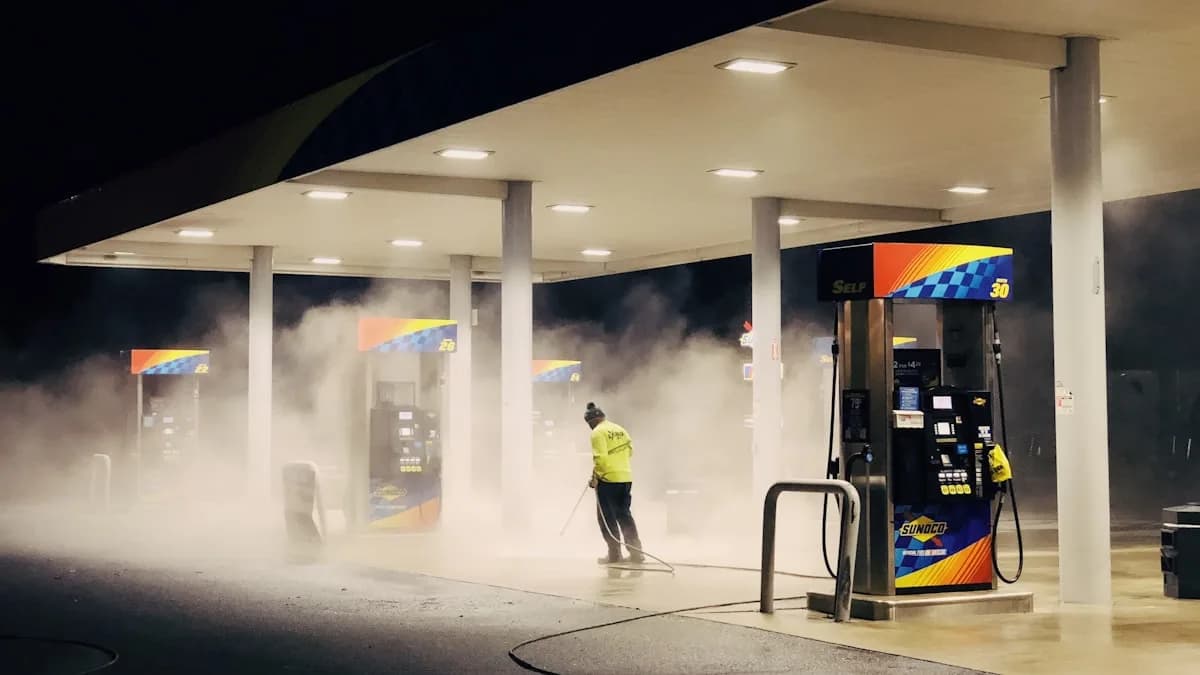
You are most likely to need a real reclaim setup and formal environmental permits on gas stations, parking lots, restaurants, and industrial sites where runoff carries oil and grease, or when you use strong degreasers. Some states, Michigan among them, require an environmental or wastewater registration for commercial work. Budget $500 to $3,000 or more for vacuums, berms, and collection tanks if you go after commercial accounts, and call the local stormwater agency before you start.
Warning: A single stormwater complaint on a commercial job, with no containment in place, can mean fines and a lost contract. If you want the restaurant and parking-lot money, the reclaim gear is not optional. It is the cost of entry.
What It Actually Costs to Start
Here is the realistic startup math for three levels of operation, pulled from current industry guides. Most new operators land in the $3,000 to $10,000 total range, driven mostly by equipment level and how much you spend on insurance and marketing.
| Cost category | Side hustle | Pro solo operator | Full commercial rig | |---|---|---|---| | Equipment and chemicals | $1,500-$2,500 | $4,000-$8,000 | $20,000-$40,000 | | License and insurance | $800-$1,500 | $800-$2,000 | $2,000-$4,000 | | Marketing and branding | $200-$500 | $500-$2,000 | $1,000-$3,000 | | Total | $2,500-$4,500 | $5,500-$12,000 | $23,000-$47,000 |
Figures from workzen, mchenrypcs, and lucidbots.
The honest recommendation: start in the side-hustle column if you already own a usable truck. You can be cash-flow positive within a handful of jobs because the side-hustle setup is cheap and the per-job revenue is high. Reinvest your first season's profit into the pro setup rather than financing it before you have proof the work is there.
How to Price Your Jobs
Pricing is where new operators leave the most money on the table. They quote a number that "feels about right," win the job, and discover they made $14 an hour after fuel and chemicals. Price deliberately instead, run a real job through a free job pricing calculator, and check the field service math before you trust your gut.
There are three ways to price, and good operators use all three depending on the job.
Per square foot works for large or repeatable surfaces. Commercial pressure washing runs $0.10 to $1.00 per square foot depending on surface, staining, and access. Residential siding and flatwork tends to fall in the $0.08 to $0.50 per square foot range. Worked example: a 2,000 square foot driveway at $0.20 per square foot is $400.
Flat per-job rates are what most residential customers expect. A typical single-family house wash often runs $300 to $500, and established companies frequently refuse jobs below $250 to $300. A typical residential driveway lands around $125 to $225.
A minimum job price protects you on small jobs. Set a floor of $150 to $200 just to roll the truck, covering your time, fuel, and setup regardless of how small the surface is.
Charge more for ladder work and two- to three-story homes, heavily stained concrete, oil, rust, or graffiti, and high-liability surfaces like delicate stone. As a benchmark, platform data puts the average pressure washing task at about $52 per hour, but pricing by job or square foot rewards you for getting faster, which hourly never does.
Getting Your First Customers
The fastest path to a full schedule is local, visual, and review-driven. You are selling a before-and-after, so make the customer see it.
Start with your network at real prices, not heavy discounts. Friends, family, and neighbors give you your first jobs, your first before-and-after photos, and your first Google reviews. Those three assets are worth more than the discount you would have given.
Then build the local presence that "pressure washing near me" searches reward:
- Claim a Google Business Profile immediately so you show up in local map results.
- Post before-and-after photos on a Facebook business page and in local Facebook and Nextdoor groups. Show the work, do not spam.
- Drop door hangers in neighborhoods with visibly dirty driveways and siding. Some guides cite a 2% to 5% response rate in well-targeted areas.
- Ask for the review at the truck. After each job, text or email a direct link to your Google review page and ask.
Residential is where almost everyone should start. It is faster to book, the jobs are simpler, and you build a review base quickly. Commercial work (HOAs, property managers, restaurants, fleets) pays in recurring contracts and is worth chasing once you have proof and the runoff gear to handle it. Route density matters more than people expect: three driveways on one street beats three across town, so push neighbors to book when you are already there.
Run the Business Without Losing the Thread
The first season is fun. The second is where operators drown, not in dirty driveways, but in admin. You quoted the Hendersons by text three days ago and cannot find the number. You finished a job Tuesday and forgot to invoice it, when a free invoice generator would have had a clean bill out before you left the driveway. Two customers think they are both booked for Saturday at 9. The cleaning got easy. The business got messy.
This is the point where a system earns its place, and you do not have to pay for one to start. Fieldtics has a free tier built for exactly this: unlimited clients, job scheduling, a customer CRM, mobile-friendly web access you run from the truck, and email support, with no credit card required. You can keep every customer's address, surface notes, and job history in one place and stop running the business out of your head.
When the volume grows, the $29 a month Professional plan adds quotes and estimates, invoices and payment-status tracking, customer messages, and team scheduling. It keeps the paperwork attached to the scheduled job instead of leaving it for the end of the week.
This is the same operational backbone any field service business runs on, whether it is pressure washing, house cleaning, or a handyman crew. The trade changes. The need to schedule, track, and invoice without dropping anything does not.
Your First 60 Days
If you want a sequence to follow, here is the order that wastes the least time.
- Form your LLC, get your EIN, and open a business bank account.
- Get your general liability insurance and a business license.
- Buy the gas washer, surface cleaner, hoses, nozzles, chemicals, and PPE.
- Practice on your own property until your dilutions and soft-wash technique are dialed in.
- Set up a Google Business Profile, a Facebook page, and a free scheduling and CRM system.
- Quote real jobs, post before-and-after photos, and ask every happy customer for a review.
- Track your time and cost per job, then adjust your minimum and per-square-foot rates.
The licensing and insurance steps have the longest lead time, so start them first. Everything else can happen while you wait.
Frequently Asked Questions
How much does it cost to start a pressure washing business?
Most new operators spend $2,500 to $10,000 to start. A side-hustle residential setup using your own vehicle runs roughly $2,500 to $4,500, covering a gas washer, surface cleaner, chemicals, license, basic insurance, and a little marketing. A professional solo rig with a commercial machine and better gear runs $5,500 to $12,000.
Do you need a license to start a pressure washing business?
There is no national pressure washing license, but most cities require a general business license ($50 to $500), and you should form an LLC for liability. Some states, like California, also require a contractor's license for jobs over a dollar threshold. Check your state contractor board and local licensing office, because requirements vary widely.
How much do pressure washers make?
A seasonal side-hustle operator can earn around $54,000 a year in revenue. A full-time solo operator in a market with 8 to 9 workable months can realistically reach low six-figure annual revenue if they stay booked. Margins are high, commonly 60% to 80% on residential jobs, because consumable costs per job are small.
How much should I charge for pressure washing?
Residential house washes typically run $300 to $500, and driveways $125 to $225. For square-foot pricing, residential work falls around $0.08 to $0.50 per square foot and commercial $0.10 to $1.00. Set a minimum of $150 to $200 per job to cover the cost of rolling the truck, and charge more for ladder work and heavy staining.
What equipment do you need to start pressure washing?
At minimum: a gas pressure washer (3,000 to 4,000 PSI, 2 to 4 GPM, $800 to $1,500), a 16- to 20-inch surface cleaner ($150 to $300), 100 to 200 feet of hose, an assortment of nozzles, chemicals, and safety gear. A downstream soft-wash injector ($50 to $200) lets you clean roofs and delicate siding without damage. Skip the tank and trailer until low-flow jobs justify them.