How to Start a Landscaping Business in 2026 (Lawn Care to Full Service)

Ugo Charles
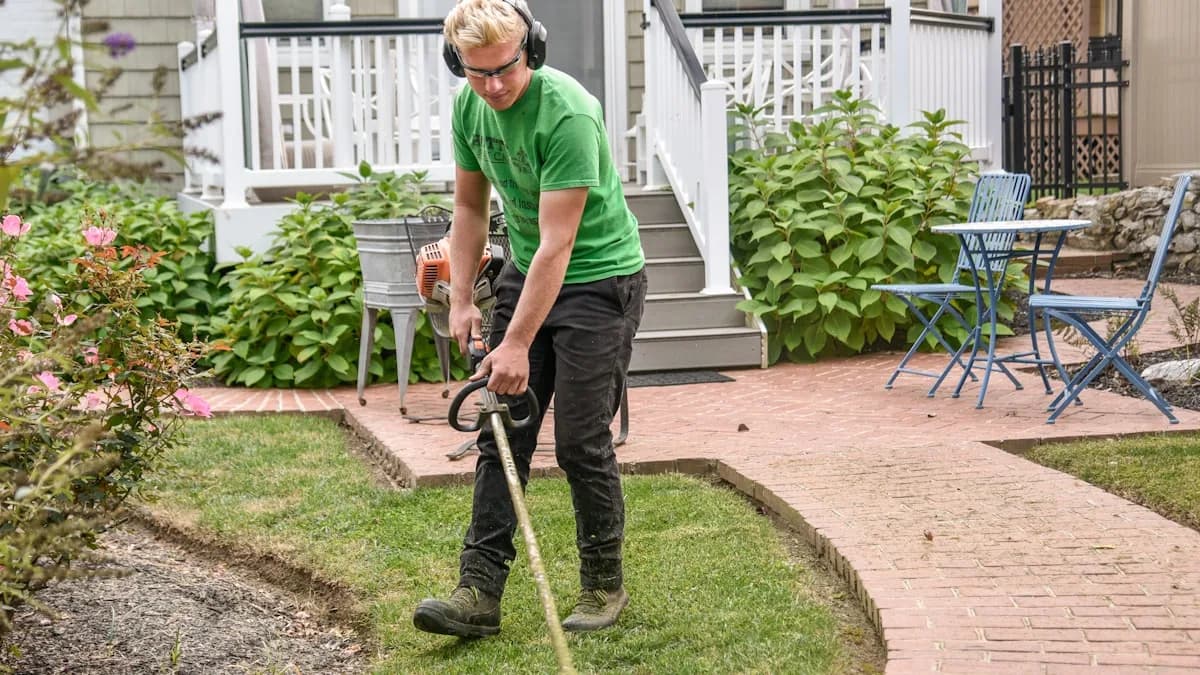
There are two kinds of people mowing lawns this summer. One has a mower in the back of a pickup, takes cash, and circles the whole city chasing jobs that pay $40 each. The other runs eight lawns on the same street, bills monthly, and is home by two. They own the same equipment. The difference is route density, and almost everything in this guide is about getting you to the second one.
Starting a landscaping business is one of the cheapest trades to enter. You can be cutting grass for money next week with gear you can buy used. But cheap to enter is also cheap for everyone else to enter, so the operators who actually make a living are the ones who treat it like a business from job one: the right license, real pricing, tight routes, and recurring contracts instead of one-off cuts.
This guide covers the whole path for the US in 2026. The lawn-care-versus-full-landscaping decision, what the equipment really costs, the licenses people skip until they get a fine, insurance, how to price per cut and per square foot, and how to land your first 20-30 customers without spending a fortune on ads.
Lawn Care vs Landscaping: Which One to Start
Start with maintenance-only lawn care. It has the lowest regulation, the fastest cash flow, and it builds the recurring customer base that everything else bolts onto.
Lawn care means mowing, trimming, edging, blowing, leaf cleanups, and light mulch work. In every US state, basic mowing and maintenance does not require a special contractor license beyond general business registration. Full landscaping means design and installs, irrigation, hardscaping (patios, walkways, retaining walls), drainage, and tree work. Many states regulate that as contracting once a job crosses a dollar threshold. California, for example, requires a C-27 landscape contractor license for any landscaping work over $500 in labor plus materials, which involves four years of journey-level experience, exams, a $12,500 surety bond, and proof of liability insurance.
So the smart play is to start lean on mowing, get a route running and cash flowing, then add fertilization, weed control, and installs as you secure the right licenses and capital. The two are not in competition. Lawn care is the on-ramp to landscaping.
What landscapers actually make
Income tracks how you build the business, not how hard you swing a string trimmer.
| Stage | Annual revenue | Owner take-home (pre-tax) | |---|---|---| | Solo, part-time / side | $20,000-$50,000 | $15,000-$35,000 | | Solo, full-time dense route | $50,000-$100,000+ | $35,000-$70,000 | | Small crew (1-3 employees) | $150,000-$400,000+ | ~$40,000-$120,000+ |
Source ranges synthesized from lawn care startup data and industry budgeting guides. The jump from $40,000 to $70,000 as a solo operator is not about working more hours. It is about a tighter route and recurring contracts so you bill more per hour on the truck and waste less on driving.
Equipment and Startup Costs (Solo to Crew)
You can technically start for $500 with a used mower and some flyers. A professionally equipped solo operation usually lands at $5,000-$8,000 for equipment, basic marketing, and working capital, not counting a truck.
Here is the bare-bones lawn care setup with 2026 price ranges:
| Item | Cost (USD) | |---|---| | Commercial walk-behind or zero-turn mower | $3,000-$10,000 | | String trimmer | $200-$400 | | Backpack or handheld blower | $250-$600 | | Hand tools (rakes, shovels, spreader, shears) | $100-$400 | | Trailer (using existing vehicle) | $1,000-$3,000 | | Gas cans, PPE, blades, oil, spares | $200-$600 | | Scheduling and invoicing software | $0-$50/mo |
Numbers from LawnStarter and Lawn Love. A used work-ready truck adds $10,000-$25,000 on top, but most people start with a personal pickup and a small trailer rather than buying a dedicated vehicle on day one.
The lean start: A used commercial mower, a trimmer, a blower, a trailer hitched to the truck you already own, and a stack of door hangers. That is a real business. Buy quality used where you can and upgrade as the route fills, not before.
If you want to skip straight to design, installs, and hardscaping, the math changes hard. A full-service landscaping launch with skid steers, a mini-excavator, plate compactors, a dump trailer, and multiple trucks runs $15,000-$50,000 or more. That is another reason to start with mowing and grow into the heavy stuff. Fencing is a common bolt-on once you own the truck and trailer, and a free fence material calculator turns linear feet into a post-and-panel count so your install estimate holds up.
Beyond equipment, budget for the rest of launch: business registration ($50-$300), a simple website ($100-$1,200), business cards, yard signs, and door hangers ($100-$500), first-month fuel and parts ($200-$800), and a buffer of two to four weeks of expenses. None of it is huge, but it adds up, so plan it instead of bleeding it from the first few jobs.
Register and License Your Business
For basic lawn care in most of the US, registration is short. The license that trips people up comes later, when they start spraying.
Business registration (every state)
Set up the legal shell before your first paid job:
- Choose a structure. An LLC is the common pick for liability protection. State filing is usually $50-$200, often around $100.
- Get an EIN from the IRS. It is free and takes minutes online.
- Apply for a local business license from your city or county, commonly $50-$300 per year.
- File a DBA / trade name if you are not operating under your own legal name, often $20-$100.
- Register for sales tax if your state taxes lawn care services. Check your state Department of Revenue, since this varies.
Costs and steps from Lawn Love and the Housecall Pro licensing guide.
The pesticide license most people miss
This is the requirement that gets new operators fined. The moment you apply herbicides, insecticides, fungicides, or many commercial fertilizers for hire, most states require a commercial pesticide applicator license, and often a separate business or operator license for the company on top of it.
A homeowner spraying their own yard is usually exempt. You, applying for pay, are not. The pattern repeats across states with different price tags:
- Washington: Commercial Applicator License at $250/year per individual, plus a Commercial Pesticide Operator License for the business, plus a $25 laws-and-safety exam and a $25 Ornamental and Turf (category 03) exam, per Washington's requirements.
- Louisiana: Businesses that apply pesticides must be licensed, employ at least one certified commercial applicator, and pay $200 for residents or $500 for non-residents.
- Illinois: Anyone applying pesticides in the course of employment, restricted-use or general, must be licensed through the Illinois Department of Agriculture after passing an exam.
- Kansas: Commercial lawn care companies doing chemical applications need commercial applicator certification through the state's Pesticide and Fertilizer Program.
Nationally, exams and license fees for ornamental and turf work tend to land in the $50-$500 range. Find your state Department of Agriculture's pesticide licensing page before you sell a single fertilization plan. If you stay mowing-only at first, you sidestep this entirely, which is one more argument for starting with maintenance and adding chemical service deliberately.
Warning: Spraying weed-and-feed for a paying customer without the applicator license is illegal in most states. The fine plus a damaged reputation costs far more than the exam fee. License first, sell second.
Insurance You Actually Need
Most states do not legally mandate general liability for a lawn business, but customers, HOAs, and commercial property managers routinely require proof of coverage before they sign. Two policies matter from the start.
General liability covers property damage and injury claims, the classic being a rock thrown by a mower through a window or a parked car. Small operators typically carry $1 million per occurrence and $2 million aggregate, and it runs roughly $350-$1,200 per year.
Commercial auto covers your truck or van when it is working. Your personal policy will not. Budget $1,000-$3,000+ per year per vehicle depending on your record and the vehicle.
Once you hire, workers' compensation becomes mandatory in most states. Landscaping rates often run $0.50-$2.00 per $100 of payroll, climbing toward the high end for tree work and hardscaping. You can add a business owners policy, inland marine for tools in transit, and umbrella coverage as you grow, but general liability and commercial auto are the two that get you in the door on real accounts.
How to Price: Per Cut, Per Square Foot, and Contracts
Price from your costs, not from what the guy down the street charges. Work out your operating cost per hour (fuel, maintenance, insurance, your own labor, admin), add the margin you need, and convert that into per-job prices. A free job pricing calculator handles that build-up for you, and then you sanity-check against local rates.
Per-cut residential mowing
Most operators charge a flat rate per visit based on lot size and complexity, with a minimum service price so small lots are still worth the stop:
- Small city lots (up to ~5,000-7,500 sq ft of turf): a minimum-service price, often $35-$50+ per cut
- Medium lots (~8,000-12,000 sq ft of turf): commonly $45-$70 per cut in many markets
- Larger lawns: priced up, sometimes with a per-1,000-sq-ft upcharge over a base package
These are framework ranges, not gospel. Adjust to your market and your real cost per hour.
Per square foot for projects
For sod, mulch, rock, and bed renovation, quote per square foot for materials plus labor, or per cubic yard for mulch with a minimum trip charge, and on a rock or path job a free gravel calculator nails the tonnage before you order so the load does not eat your margin. Always back-solve from your target hourly rate so a "good price" on paper does not turn into a money-losing day on site. When you win the work, a free estimate generator gets a tidy written quote in front of the customer before they shop the next bid.
Recurring contracts are the whole game
The profitable lawn businesses run on recurring maintenance agreements, not one-off cuts. Weekly or biweekly mowing across the growing season (often 26-32 visits a year depending on climate), billed as a flat monthly payment covering mowing, edging, blowing, and seasonal cleanups. Commercial clients sign annual contracts.
Recurring work smooths your cash flow, makes scheduling predictable, and tightens your routes because the same customers come up on the same days. It also raises what the business is worth if you ever sell. A route full of contracts is an asset. A pile of one-time cuts is just this week's work.
Getting Your First 20-30 Customers
Early customers come from local, trust-based marketing, and the goal is not just volume. It is volume clustered into a tight route.
- Claim your Google Business Profile. It is free and it is how people find "lawn care near me." Add before-and-after photos, your service area, and ask every happy customer for a review.
- Work the neighborhood. Door hangers and flyers in target streets, plus a yard sign at every job you are allowed to post (a simple "Lawn maintained by [your company name]" board). Neighbors see the sign and the truck every week.
- Offer same-day-route discounts. Give a small break to neighbors who sign up for your existing visit day. It costs you a few dollars and buys you density, which is worth far more in saved drive time and fuel.
- Use referrals. A $20 credit for both the referrer and the new customer turns happy clients into a sales force.
- Treat lead apps as a feeder. Angi, Thumbtack, and lawn-care marketplaces bring early volume at lower margins. Use them to fill gaps, not to build the whole business.
- Network for recurring work. Real estate agents, property managers, HOAs, and small builders are steady sources of contracts.
The operator who signs eight houses on one street beats the one who signs eight houses across town, even at the same price per cut. One spends the afternoon mowing. The other spends half of it driving.
Run the Route, Not Your Memory
Once you have 15-20 recurring customers, the bottleneck stops being demand and becomes coordination. Which lawns are due this week, which got skipped for rain, who paid, who is three cuts behind. Run that out of your head and you will miss visits and forget invoices, which is exactly how a busy lawn business still ends up broke.
This is where software earns its keep, and you do not need to pay for it to start. Fieldtics has a free tier with unlimited clients, job scheduling, a customer CRM, mobile-friendly web access, and email support, no credit card required. That covers scheduling recurring mows, keeping every property's history straight, and running the day from your phone between jobs. Because lawn care lives and dies on route density, grouping jobs by neighborhood instead of scattering them across the calendar is the single highest-leverage thing the schedule does for you.
When you are ready to bill the moment the blower stops, the Professional plan at $29/month adds quotes and estimates, invoices and payment-status tracking, team scheduling, and customer messages. That is the upgrade most operators make when they add a second crew member or start sending more than a handful of invoices a week. Tools like Jobber and Yardbook cover similar ground, but they gate basic features behind paid tiers sooner, which matters when you are still building your first route. The deeper breakdown is in our guide to the best field service management software for small businesses, and the lawn care scheduling software page shows how the routing works for this trade specifically.
The point is not fancy software on day one. It is having any real system before you have so many lawns that the whiteboard stops working.
Frequently Asked Questions
How much does it cost to start a landscaping business?
A professionally equipped solo lawn care startup runs $5,000-$8,000 for a commercial mower, trimmer, blower, hand tools, a trailer, and basic marketing, not counting a truck. You can start leaner with used gear for as little as $500. A full-service landscaping launch with heavy equipment runs $15,000-$50,000 or more.
Can you start a landscaping business with no experience?
Yes. Maintenance-only lawn care (mowing, trimming, edging, blowing) needs no special license beyond business registration in every US state, and the skills are learnable fast. Start there, build a recurring route, and add fertilization, weed control, and installs as you gain experience and the required state licenses.
What licenses do you need for a lawn care business?
For basic mowing you need a local business license and business registration (often an LLC), plus an EIN. The license most people miss is the commercial pesticide applicator license, required in most states the moment you apply herbicides, fungicides, or commercial fertilizers for hire. Installs and hardscaping can trigger a state contractor license.
How much do landscapers make?
A full-time solo operator with a dense route and recurring contracts typically takes home $35,000-$70,000 a year before taxes on $50,000-$100,000+ in revenue. A small crew of one to three employees can generate $150,000-$400,000+ in revenue, with owner pay and profit often targeted at 10-30% of that in a well-run shop.
Start Lean, Then Tighten the Route
The cheapest way into the trades is also the easiest place to stay stuck, mowing all over town for cash and calling it a business. The operators who break out do four unglamorous things early: they register properly and get the pesticide license before they spray, they price from their costs instead of guessing, they sell recurring contracts instead of one-off cuts, and they cluster those contracts into tight neighborhood routes.
If you do one thing this week, map your target neighborhoods before you buy a single ad, then sign up streets, not scattered houses. Set up your schedule and client list in Fieldtics for free so the route is organized from the first lawn, the same way HVAC operators do it in our guide to starting an HVAC business and pressure washers do in the pressure washing startup guide. The math behind pricing each job for actual profit is in our breakdown of field service business math. A mower is cheap. A full route that bills itself every month is the actual business.