Best Cleaning Business Apps for 2026

Ugo Charles
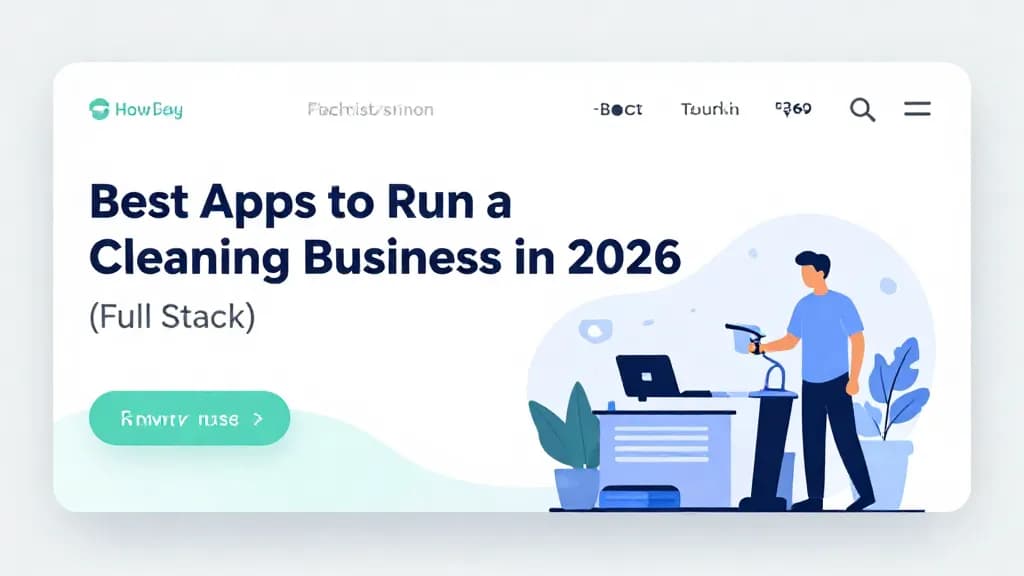
The notebook and the group text work right up until they don't. You are cleaning the Garcias' place on Tuesday, you booked a move-out for Friday, a new client wants a quote, and somewhere in your camera roll is a photo of a check you still have not deposited. Running a cleaning business out of your phone means running it out of six different apps that don't talk to each other, or one app that was built for a restaurant.
This is the full stack of apps a cleaning business actually needs in 2026, sorted by the job each one does: scheduling, invoicing, payments, accounting, customer messaging, and reviews. Fieldtics is our pick for the core because it covers the first few jobs on one free plan, and we name the honest alternatives for every layer after that. All prices are US list prices as of July 2026. Confirm the live number before you sign up, since payment and software pricing moves often.
The six jobs your app stack has to cover
Before you download anything, get clear on what the stack is for. A cleaning business runs on six repeating jobs, and most owners try to do all of them in a calendar app and a notes app.
- Scheduling and dispatch. Recurring weekly and biweekly cleans, plus who is assigned to which house today.
- Invoicing. A professional invoice that goes out the day the job is done, not three weeks later.
- Payments. A way for the client to pay by card or bank transfer from their phone.
- Accounting. Income and expenses tracked so tax time is not a shoebox of receipts.
- Customer messaging. Booking links, day-before reminders, and "we're on the way" texts.
- Reviews. A steady drip of Google reviews so new clients find you.
You do not need six subscriptions. The smart move is one core app that handles scheduling, CRM, invoicing, and reminders together, then a payment processor and accounting tool bolted on. That is the stack we build below.
Scheduling and dispatch: the core of the whole business
Recurring scheduling is the foundation. Every other app plugs into it. If the tool that holds your calendar cannot set an every-other-Tuesday clean once and generate every future visit, the rest of the stack is patching a hole you keep tearing open.
Fieldtics is our top pick and where most cleaning businesses should start. The free plan covers unlimited clients, recurring job scheduling, a client CRM, and mobile-friendly web access, with no credit card required. The client CRM is the part cleaners underrate: gate codes, dog names, "skip the home office," and product allergies live on the client record where anyone on the crew can pull them up on site. When you hire your second cleaner, the $29/mo Professional tier adds team scheduling and dispatch so every job has an owner.
If you want to test-drive the assignment logic before you commit, the crew schedule planner lets you map cleaners to jobs across a week in your browser. For the deeper comparison of dedicated calendar tools, our scheduling app for cleaning businesses guide ranks the free and paid options side by side.
The alternatives worth knowing: Connecteam is genuinely free up to 10 users and fits better if you think in employee shifts and want time tracking baked in. Jobber is the heavier all-in-one, strong but starting around $29/mo per user with no free tier, which prices out a lot of solo operators. For the full field of tools rather than just the calendar layer, see our roundup of the best cleaning business software.
Invoicing: get paid the day the job is done
A handwritten total or a Venmo request after a $300 deep clean reads as amateur and gets paid late. The fix is an invoice the client can open and pay from their phone, fired off the moment you mark the job complete.
If your scheduling app already invoices, use that so the client, the job, and the bill all live in one place. Fieldtics Professional includes invoicing and quotes at $29/mo, which is the cleanest path because the invoice inherits the client and job you already scheduled.
If you are not ready to pay for a scheduling suite yet, run invoicing standalone. invoicepdf.io is a free invoice app that produces a clean, professional PDF you can send in a minute, with no subscription. Our own free invoice generator does the same job in the browser. Either one beats a spreadsheet total, and both keep your solo software cost near zero.
The rule of thumb: invoice from your scheduling app once you are paying for one. Until then, a dedicated free invoice tool is the right call.
Payments: how the money actually moves
Once the invoice is out, the client needs to pay it. For a small cleaning business, the real choice is between three processors, and the difference is a few tenths of a percent that adds up across a full book of recurring clients.
Here is how the three shake out on standard 2026 pay-as-you-go pricing, per each vendor's published rates:
| Processor | Card, in person | Online invoice or link | ACH bank transfer | |---|---|---|---| | Square | 2.6% + $0.15 | 3.3% + $0.30 | 1%, $10 cap | | Stripe | 2.7% + $0.05 | 2.9% + $0.30 | 0.8%, $5 cap | | QuickBooks Payments | ~2.5% | ~2.9% | 1%, $10 cap |
None of the three charges a monthly or setup fee on the basic plan, so you only pay when you get paid. Square is the simplest for tapping a card on site with just your phone. Stripe is a touch cheaper online and has the lowest ACH fee, which matters if you bill larger commercial or recurring clients who can pay by bank transfer. QuickBooks Payments is worth it mainly if you already run QuickBooks accounting and want the payment to reconcile itself.
For a residential book of $150 to $400 jobs, steer clients toward ACH where you can. On a $400 clean, ACH at 1% capped at $10 costs $4, while a card at 3.3% plus $0.30 costs $13.50. That gap is real money over a year. We break the tradeoffs down further in our guide to payment processing for contractors.
Accounting: so tax season is not a shoebox
You can run scheduling and invoicing without accounting software for a while, but the day you have real expenses, supplies, mileage, a second cleaner on payroll, you want the books in one place.
- QuickBooks Online is the default for a reason. It is what most bookkeepers already use, it integrates with field-service tools, and every accountant in the country knows it. Start here unless you have a specific reason not to.
- FreshBooks is easier for a true solo operator and is marketed straight at service businesses, with simple invoicing and time tracking. Fewer advanced features, but a gentler learning curve.
- Wave is the free option. Basic, but real accounting at $0 for a side-hustle or first-year cleaner watching every dollar.
The honest stance: if you plan to hire and grow, go QuickBooks Online now and grow into it. If you are solo and staying that way, FreshBooks or Wave will not hold you back.
Customer messaging: reminders and booking links
The cheapest no-show insurance you can buy is a text the day before. That feature lives inside your scheduling app, which is one more reason to keep the core consolidated rather than bolting a separate SMS tool on top.
A booking link does the other half of the work. Instead of a three-text back-and-forth to find a slot, the client picks an open time and the job lands on your calendar. Fieldtics does not currently include public self-booking, so pair it with a standalone tool like Calendly if that workflow is important, then copy confirmed bookings into the job calendar.
Reviews: the app that grows your pipeline
New residential clients find cleaners on Google. A steady flow of recent, positive reviews is what makes your business the one they call, and the way to get them is to ask every happy client right after the job, automatically.
- NiceJob is the most cleaning-specific dedicated tool. It sends review requests by text and email after a job and pushes the reviews to Google and Facebook.
- Google Business Profile is free and non-negotiable. Even if you use nothing else, claim your profile and ask for reviews there directly. It is the listing that shows up in the local map pack.
- Angi is a lead marketplace as much as a review platform, useful for building reputation and sourcing home-service jobs, though you pay for the leads.
For a solo cleaner, the honest minimum is a claimed Google Business Profile and a manual text asking for a review after every job. Add NiceJob when you are large enough that automating the ask is worth the subscription.
The default cleaning business app stack
Pulling it together, here is what a sensible stack looks like at each stage. You do not need every tool on day one.
| Stage | Scheduling + CRM | Invoicing | Payments | Accounting | Reviews | |---|---|---|---|---|---| | Solo, just starting | Fieldtics (free) | invoicepdf.io (free) | Square | Wave (free) | Google Business Profile | | Solo, established | Fieldtics Professional | Fieldtics | Square or Stripe | FreshBooks | Google + manual asks | | Small crew (2-10) | Fieldtics Professional | Fieldtics | Stripe | QuickBooks Online | NiceJob |
The pattern holds across the trades. A carpet cleaning, landscaping, or pest control business needs the same six layers, just with different job types on the calendar. What changes is the scheduling core, and consolidating it is what keeps the whole stack from turning back into six apps that don't talk.
Two more tools worth bookmarking while you set pricing: our house cleaning cost calculator for quoting jobs, and the house cleaning rates guide for benchmarking what to charge in your area. If you are still getting the business off the ground, start with how to start a cleaning business.
Where to start
Do not buy six subscriptions this week. Start with the core: put your recurring cleans, your clients, and your reminders in one free tool, and add a payment processor when the first invoice goes out. Everything else, accounting, reviews, a paid invoicing suite, layers on as you grow.
Start free with Fieldtics to get scheduling, unlimited clients, and the client CRM on one plan, no credit card required. When you hire your second cleaner and start billing from the app, the $29/mo Professional tier adds team dispatch, invoicing, customer reminders, and payment-status tracking in the same place.
Frequently asked questions
What apps do I need to run a cleaning business?
At minimum, scheduling with a client CRM, invoicing, and a way to take card payments. Most cleaning businesses also want accounting software for taxes, reminders to cut no-shows, and a review tool to grow on Google. Fieldtics covers scheduling and CRM on its free plan, then adds invoicing and customer reminders on Professional; use a separate processor and accounting tool where needed.
What is the cheapest way to run a cleaning business with software?
Start on free tiers. Fieldtics is free for scheduling, unlimited clients, and the CRM. Pair it with a free invoice app like invoicepdf.io and a pay-as-you-go processor such as Square or Stripe that charges only per transaction. A solo cleaner can run on close to $0 a month in software until they hire.
Should I use one all-in-one app or separate apps?
Consolidate the core, keep payments and accounting separate. Scheduling, CRM, invoicing, and reminders belong in one tool because they share the same client and job data. Payments and accounting are specialized enough that a dedicated processor and QuickBooks or FreshBooks will serve you better than a bundled version of either.
Do I need accounting software right away?
Not on day one. A solo cleaner can start with just scheduling and invoicing and add Wave or FreshBooks once real expenses show up, or QuickBooks Online the moment you hire or start tracking payroll and mileage seriously.
What payment app is best for a cleaning business?
Square and Stripe are the two to compare. Square is simplest for taking a card on site, around 2.6% plus $0.15 in person. Stripe is slightly cheaper online at 2.9% plus $0.30 and has the lowest ACH fee at 0.8% capped at $5, which helps with larger recurring commercial clients paying by bank transfer.
Frequently asked questions
- What apps do I need to run a cleaning business?
- At minimum you need scheduling and a client CRM, invoicing, and a way to take card payments. A cleaning business also benefits from accounting software for taxes, a reminder system to cut no-shows, and a review tool to grow on Google. Fieldtics covers scheduling, CRM, invoicing, and reminders on one free plan, so most solo cleaners start there and add a payment processor and QuickBooks as they grow.
- What is the cheapest way to run a cleaning business with software?
- Start on free tiers. Fieldtics is free for scheduling, unlimited clients, the client CRM, and automated reminders with no credit card required. Pair it with a free invoice app like invoicepdf.io and a pay-as-you-go payment processor such as Square or Stripe that charges only per transaction. You can run a solo cleaning business for close to $0 a month in software until you hire.
- What payment app is best for a cleaning business?
- For most small cleaning businesses, Square and Stripe are the two to compare. Square is simplest for taking a card on site with a phone, at about 2.6% plus $0.15 in person. Stripe is slightly cheaper online at 2.9% plus $0.30 and has the lowest ACH fee at 0.8% capped at $5, which matters for larger recurring commercial clients.